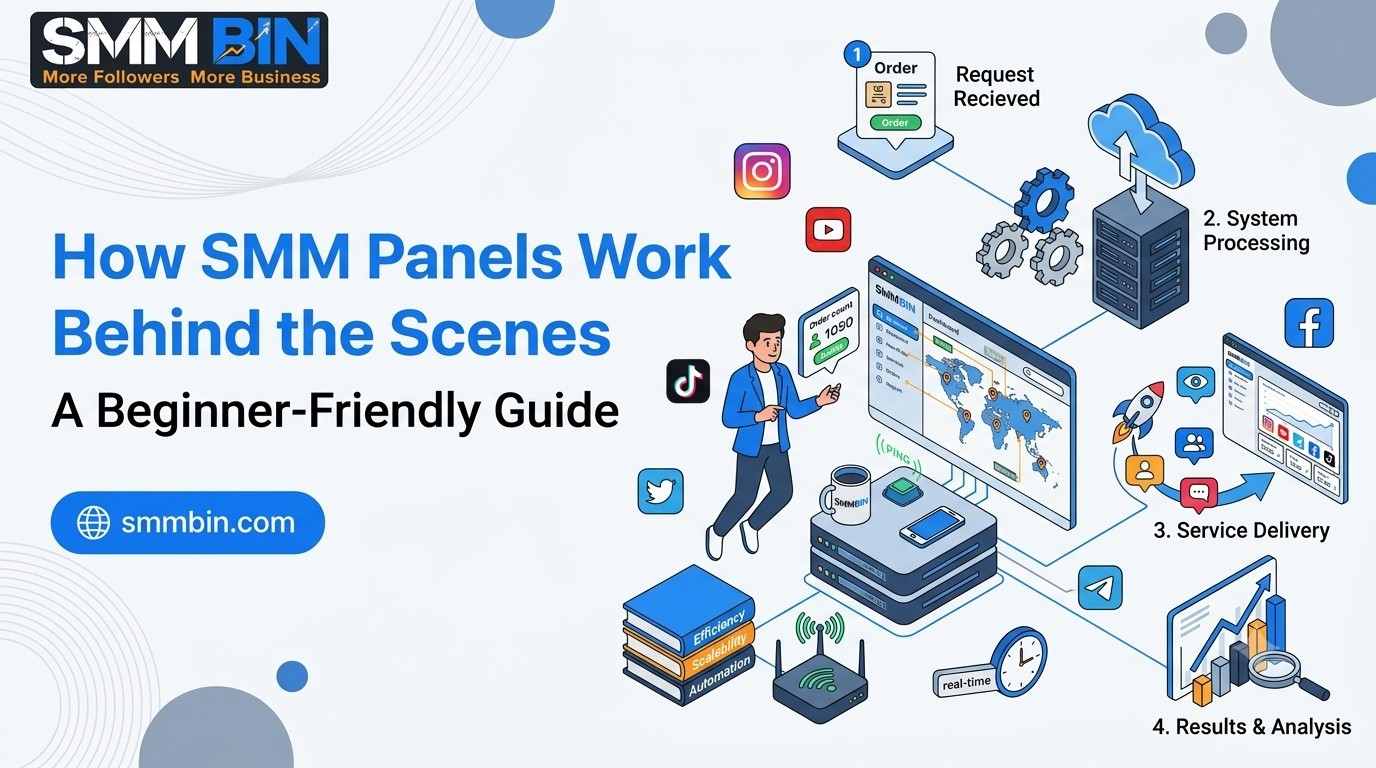
To the everyday user, a Social Media Marketing (SMM) panel looks like a simple digital store: you select a platform, paste an Instagram link or YouTube video URL, choose a quantity, and complete checkout. Minutes later, the counters on your target profile begin ticking upward.
Behind that minimalist dashboard lies an intricate technical pipeline built on automated server nodes, API endpoints, load-balancing databases, and provider networks. Understanding this ecosystem helps you select reliable services, troubleshoot stuck orders, and manage campaigns safely.
The 4-Stage Architectural Pipeline
[1. User Order Placed]
         │
         ▼
[2. Database & API Router Validation]
         │
         ▼
[3. Provider Server Execution & Network Delivery]
         │
         ▼
[4. Automated Webhook Status & Real-Time Sync]
Stage 1: Order Ingestion & Parameter Validation
When you submit an order on
URL Format Verification: Validates that the link matches the platform's profile, post, or reel syntax.
Account Privacy Check: Confirms the profile is public (private accounts reject automated pings).
Balance Deduction: Debits the exact package cost from your account balance atomically to prevent race conditions.
Stage 2: The API Bridge & Load Balancing
Modern SMM platforms do not manually process tasks. Instead, an automated Application Programming Interface (API) acts as an intermediary:
The system packages your order into a JSON payload containing the
service_id,link,quantity, and special instructions (e.g., custom comments or drip-feed schedules).The routing engine selects the fastest, highest-capacity server node available from its distributed network.
Read more blog : Affordable SMM Panels: What You Should Look For
Stage 3: Service Execution & Traffic Delivery
Once routed, the server executes delivery using specialized dispatch methods:
Direct Server Nodes: Automated machines send structured HTTP requests to simulate views and interactions.
Incentive Networks & Micro-Task Hubs: Genuine users in affiliate reward ecosystems perform tasks like watching a video or following a page in exchange for micro-credits.
Proxy-Rotated Pools: Residential and mobile proxy networks distribute activity across thousands of clean IP addresses to prevent rate limits and ensure smooth delivery.
Stage 4: Webhook Monitoring & Status Updates
As the action takes place, the provider network constantly returns status webhooks back to the central panel:
Pending: Order received and awaiting server allocation.
In Progress: Packets are actively being delivered to the target link.
Completed: Target quantity verified by the system.
Partial / Refunded: If a target link changes or drops off mid-delivery, the system calculates the undelivered balance and credits your wallet automatically.
3. The Core Mechanics: Key Concepts Explained
| Component | Function | Why It Matters |
| API Endpoints | Direct code communication between panels | Enables instant processing without manual human delay |
| Drip-Feed Technology | Scheduled metric delivery over hours or days | Prevents unnatural spikes that alert platform spam algorithms |
| Residential Proxies | Real ISP IP addresses used to route pings | Masks automated calls to look like organic mobile traffic |
| Refill Triggers | Automated checks against original baseline counts | Replaces lost metrics if native platforms run routine cleanups |
4. Why Delivery Speed Varies Between Services
Not all services on an SMM panel operate on the same logic:
Instant vs. Gradual Delivery
Fast-Delivery Services: Engineered for speed. Ideal when you release a reel or short and need initial velocity within 15 minutes to test explore-page hooks.
Drip-Feed Services: Engineered for safety and longevity. Breaks an order of 10,000 views into 500 views every 3 hours over several days, mimicking organic viral growth.
High-Retention vs. Standard Metrics
Standard views register the minimal watch-time threshold (often 3 to 10 seconds). High-retention servers instruct connections to stay active for 60% to 100% of the video duration, which signals genuine viewer interest to algorithms on platforms like YouTube and TikTok.
5. How Reseller Panels Tap Into the Backend
For agencies and entrepreneurs, the beauty of the SMM architecture is its interoperability. Through standard REST APIs, any webmaster can connect their own storefront directly to SMMBin:
You install an SMM script or WordPress/WooCommerce plugin on your site.
You connect your unique API key provided by your SMMBin dashboard.
Your customers order from your storefront at your retail price.
Your website instantly passes the order to SMMBin at wholesale cost.
The delivery runs silently in the background, allowing you to run a hands-off digital business.
6. Frequently Asked Questions
Does someone manually fulfill my order?
No. High-tier platforms like SMMBin operate fully automated API workflows that run 24 hours a day, 7 days a week.
Why do some orders take longer to start than others?
Certain complex services (like high-retention YouTube watch hours or country-targeted followers) queue through specialized networks with deliberate pacing to protect channel integrity.
How does the refill system actually work?
When an order includes a refill guarantee, the system records your start and target counts. If platform cleanups cause numbers to dip below the target within the guarantee window (e.g., 30 days), triggering the refill button pings the servers to top up the difference automatically.
Leverage Professional Automation for Your Growth
An SMM panel is not magic—it is automated network infrastructure designed to give your content the initial push it needs in an algorithm-dominated landscape. When you understand the systems running behind the dashboard, you can build smarter campaigns, protect your profiles, and scale efficiently.
Explore reliable, high-speed automated services built for creators and agencies at